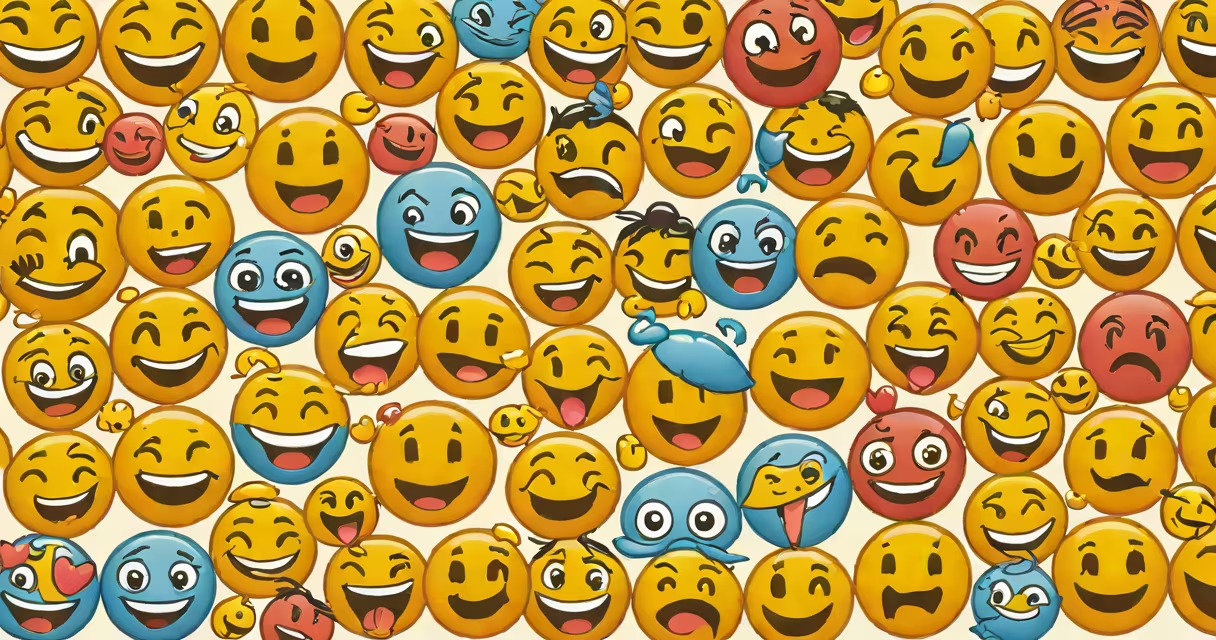
Emoji faces convey specific emotional states or social intentions through standardized visual symbols used in digital messaging. They function as shorthand for tone, intent, and affect in text-based communication.
Each emoji face is designed with distinct facial features-eye shape, mouth curvature, eyebrow position-that align with established principles of facial expression recognition. The Unicode Consortium standardizes these visuals, ensuring consistency across platforms. For example, the 😊 emoji uses wide-open eyes and a gentle upward curve in the mouth to signal mild happiness or friendliness.
Research from the University of California, San Diego, shows that people interpret emoji with consistent accuracy across cultures. A 2021 study published in *Computers in Human Behavior* found that 87% of participants correctly identified the intended emotion behind commonly used emoji, even when sent across language barriers.
Emoji faces operate through visual cues tied to human perception of emotion. They rely on universal facial expression patterns recognized globally, such as raised eyebrows indicating surprise or narrowed eyes suggesting suspicion. These signals are rooted in psychological research dating back to Paul Ekman's work on basic emotions.
When a user sends a message with a 😂 emoji, they're signaling laughter or amusement. The exaggerated eye closure and stretched mouth mimic the physical act of laughing. This isn't arbitrary-it reflects actual muscle movements seen during genuine laughter, validated by biomechanical studies of facial motion.
Text without emoji often lacks tonal clarity. A message like "That was funny" can read as sarcastic or neutral depending on context. Adding 😂 reduces ambiguity. A 2020 analysis by the Pew Research Center found that 69% of adults in the U.S. use emoji to clarify tone in texts, especially in informal or emotionally charged exchanges.
Emoji faces fall into categories based on emotional valence and intensity. The following table outlines key types, their visual markers, and typical usage contexts.
| Emoji | Emotion/Intention | Visual Cues | Usage Context |
|---|---|---|---|
| 😊 | Mild happiness, politeness | Smiling mouth, open eyes | Agreement, light approval, softening criticism |
| 😂 | Intense amusement, laughter | Teared eyes, wide mouth, tilted head | Reacting to jokes, sharing funny moments |
| 🤔 | Thoughtfulness, doubt | Brow furrowed, hand under chin | Considering options, questioning validity |
| 😞 | Disappointment, sadness | Downward mouth, drooping eyes | Expressing regret, acknowledging failure |
| 😤 | Frustration, anger | Steam from ears, clenched jaw | Reacting to injustice, expressing irritation |
Some emojis blend multiple emotions. The 😅 emoji, for instance, combines a sweating face with a wide grin. It signals nervousness mixed with humor-commonly used when someone says something awkward but tries to deflect tension with self-deprecating humor.
Platform-specific variations exist. Apple's version of 😅 shows slightly more dramatic sweat droplets than Google's. However, the core meaning remains consistent due to Unicode standardization. This prevents misinterpretation across devices.
People often assume emoji carry universal emotional weight. That's not always true. The 😏 emoji-a smirking face with half-closed eyes-is frequently interpreted as flirtatious or sly. But in some contexts, it can signal sarcasm or passive-aggressive tone, especially in written exchanges between coworkers.
A non-obvious fact: the 😍 emoji (heart-shaped eyes) doesn't mean romantic love in all cases. It's often used to express admiration or infatuation toward celebrities, products, or achievements. A 2022 survey by Emojipedia revealed that 43% of users applied 😍 to describe enthusiasm about new tech releases, not relationships.
Another misconception is that emoji replace words entirely. They don't. They improve them. A message saying "I'm sorry" followed by 😢 may feel more sincere than the same text without the emoji. But relying solely on emoji leads to confusion. A single 😠 emoji in a work email could be misread as hostility rather than frustration.
I once tested this in a team chat. I sent "Meeting delayed" with just the 🕒 emoji. Two colleagues responded with "Why?" and "Is it canceled?"-needing clarification. Adding "Sorry, running late" with 😬 improved understanding instantly. The emoji didn't replace the message-it supported it.
Understanding what different emoji faces mean improves digital literacy. Misreading an emoji can cause unintended conflict. A 2023 report from the Journal of Computer-Mediated Communication found that 34% of workplace misunderstandings stemmed from incorrect emoji interpretation, particularly in remote teams.
For example, sending "Great job!" with the 👍 emoji may seem positive. But in high-stakes environments like healthcare or finance, it can be perceived as dismissive if paired with no further feedback. The emoji lacks specificity and may signal minimal engagement.
Use emoji intentionally. Choose ones that match your goal: appreciation, clarification, warmth, or urgency. Avoid overusing them in formal settings. When in doubt, test messages with a trusted peer before sending.
Knowing what different emoji faces mean isn't about memorizing icons-it's about recognizing how visual language shapes connection in a text-driven world.