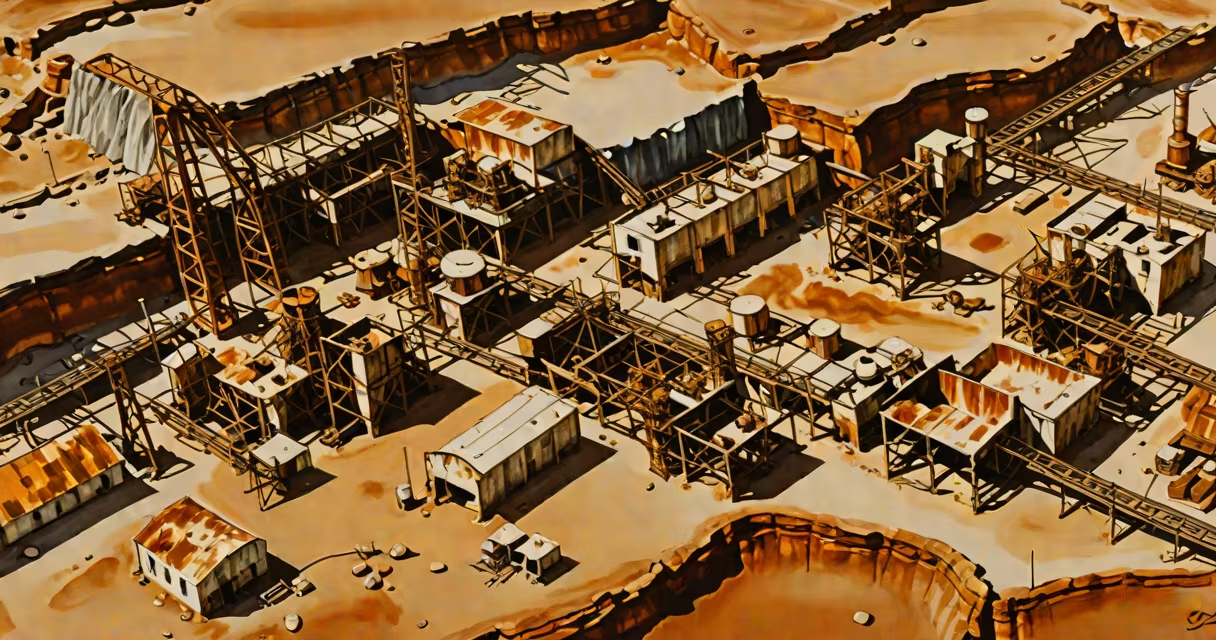
The crocodile river mine is a defunct gold mining operation located in the North West Province of South Africa, situated along the Crocodile River near the town of Klerksdorp. It was active during the late 19th and early 20th centuries, part of the broader gold rush that shaped South Africa's industrial economy.
Gold mining began in the area around 1886, following the discovery of rich gold reefs in the Witwatersrand Basin. The crocodile river mine specifically targeted deep-level reef deposits using underground shafts and tunnels. By 1910, it had reached depths exceeding 1,200 meters, employing hundreds of laborers under harsh conditions. Mining operations ceased by the 1950s due to declining ore grades and rising extraction costs.
Today, the site lies abandoned, with collapsed shafts, overgrown access tunnels, and contaminated runoff. Environmental assessments by the Council for Geoscience confirm elevated levels of heavy metals-especially arsenic and lead-in nearby soil and water samples. The site is now classified as a legacy mine with ongoing rehabilitation challenges.
Like most deep-level gold mines in South Africa, the crocodile river mine relied on vertical shafts to reach ore-bearing reefs. Miners descended via cage lifts to working levels, often operating in temperatures above 40°C and poor ventilation. Ore was extracted using hand-held drills and dynamite, then transported via narrow-gauge rail systems to surface processing plants.
Processing involved crushing rock, separating gold through cyanide leaching, and smelting the concentrate. This method released toxic byproducts into the environment. A 2018 study by the University of Pretoria found that tailings from the crocodile river mine still contain measurable concentrations of mercury and cyanide residues, even decades after closure.
Water infiltration remains a major issue. Rainwater seeps into abandoned tunnels, dissolving minerals and creating acidic drainage. This process, known as acid mine drainage (AMD), continues to pollute the Crocodile River downstream. The Department of Water and Sanitation reports that AMD from the site contributes to a 30% reduction in aquatic biodiversity in the lower reaches of the river.
South Africa hosts several categories of mining sites based on activity status and environmental risk. The crocodile river mine falls into the "legacy mine" category-abandoned, inactive, and posing long-term ecological risks.
| Type | Activity Status | Environmental Risk | Examples |
|---|---|---|---|
| Active mine | Currently extracting | High | Anglo American's Mponeng |
| Rehabilitation underway | Post-closure work in progress | Medium to high | Platinum mines in Rustenburg |
| Legacy mine | Abandoned, no current management | Very high | crocodile river mine, Sishen mine |
Legacy mines like crocodile river mine are not officially monitored by mining companies anymore. Responsibility for remediation often falls to national agencies such as the Department of Mineral Resources and Energy, which funds rehabilitation projects through the National Treasury's Mine Closure Fund.
Many assume that abandoned mines are simply closed and forgotten. In reality, the crocodile river mine remains a source of active pollution. The misconception that "once abandoned, it's safe" ignores the persistent nature of AMD and heavy metal leaching.
Another error is equating the crocodile river mine with the nearby Vaal River system. While both are in the same region, they are hydrologically distinct. The Crocodile River flows northward into the Limpopo Basin, whereas the Vaal drains into the Orange River system. Contamination from the crocodile river mine affects local ecosystems but does not reach the Vaal.
A lesser-known fact: the site was briefly considered for redevelopment as a geothermal energy pilot project in 2014. Researchers from the Council for Scientific and Industrial Research (CSIR) evaluated heat retention in deep mine shafts. The idea was scrapped due to high infrastructure costs and safety concerns, but the proposal highlights how abandoned mines can have unexpected secondary uses.
In 2021, a team from the University of Johannesburg conducted a field survey at the crocodile river mine. They collected water samples from three points: upstream (baseline), at the mine's discharge point, and downstream near a community well.
Results showed:
These levels exceed World Health Organization standards for drinking water. The study concluded that the mine's discharge continues to degrade water quality, affecting local farmers who rely on the river for irrigation.
I visited the site in 2019 with a conservation group focused on abandoned mine remediation. We entered through a collapsed access tunnel near the old headframe. Inside, the air was thick with dust and the smell of sulfur. A single rusted cable car hung from a broken pulley. The silence was absolute-no birds, no insects. That moment confirmed what data alone cannot: abandonment doesn't mean peace. It means decay, and decay demands attention.
Despite its closure, the crocodile river mine remains relevant. It exemplifies the long-term consequences of colonial-era mining practices and the uneven burden of environmental cleanup. According to the South African Government's 2022 National Environmental Management Act report, over 1,200 legacy mines exist across the country, with 40% located in the North West Province.
Efforts to reclaim such sites are slow. The National Treasury allocated R1.8 billion (about $90 million USD) in 2023 for mine closure and rehabilitation, but funding gaps persist. Communities near the crocodile river mine face health risks from contaminated water and soil. Children in nearby villages have shown elevated blood lead levels, according to a 2022 study published in the journal Environmental Health Perspectives.
Understanding the crocodile river mine is not about nostalgia-it's about accountability. The site stands as a physical record of profit-driven extraction and the cost of neglect. Its story is not unique. It is a warning and a call to action.