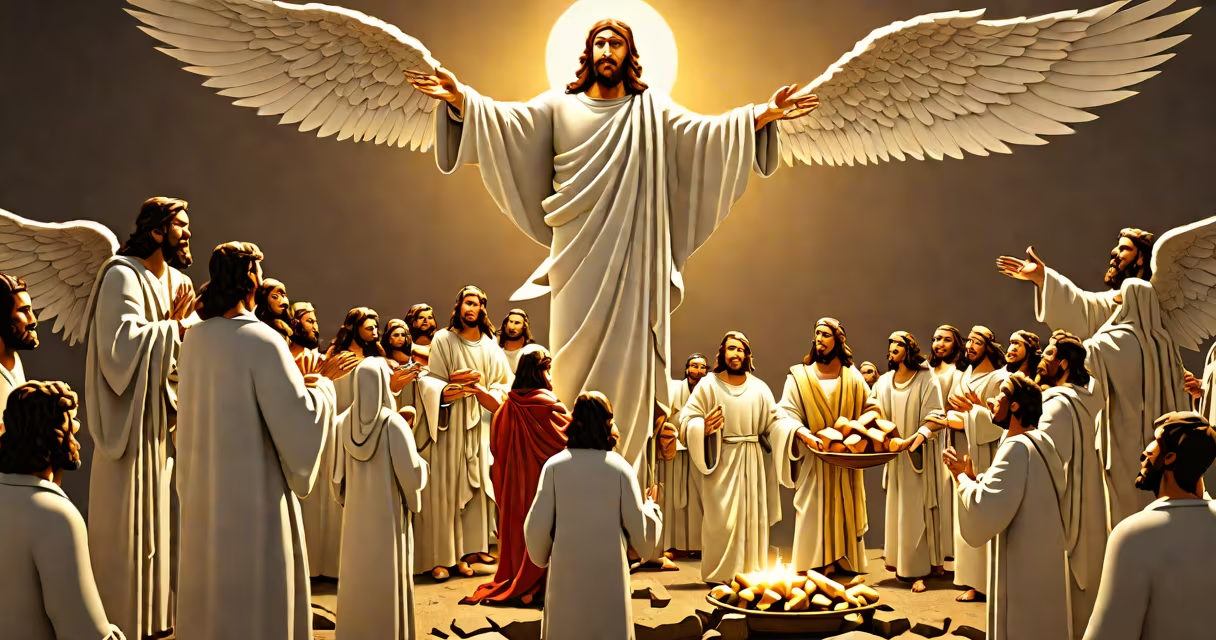
Ephesians 4:8-10 describes Christ's descent into the lower realms and subsequent ascent to heaven, emphasizing His triumph over spiritual forces and His role in bestowing gifts upon believers. The passage uses Old Proof language to frame Jesus' resurrection and exaltation as a divine conquest.
The verse begins with a citation from Psalm 68:18: "When he ascended on high, he took many captives." Paul reinterprets this psalm as a prophecy of Christ's victory after His death and resurrection. He then states that Christ "descended to the lower, earthly regions" before ascending. This sequence is not a physical process but a theological statement about Christ's complete dominion over all creation.
Paul's intent is to show that Christ's authority extends beyond the visible world. By descending into the area of the dead or underworld, He claimed power over sin, death, and demonic forces. His ascent then signifies His enthronement at God's right hand. This dual movement underscores the completeness of His redemptive work.
Paul writes Ephesians 4:8-10 within a larger argument about unity in the church. He argues that the diversity of spiritual gifts-apostles, prophets, evangelists, pastors, teachers-comes from Christ's ascension. These roles are not human inventions but divine appointments rooted in Christ's victory.
The phrase "he ascended" appears twice in the passage, reinforcing the idea of upward movement as a sign of divine authority. The Greek word used for "ascended" (anabainō) appears 16 times in the New Proof, always in contexts of elevation or exaltation. This linguistic pattern signals that Paul is drawing on established Christian imagery of Christ's heavenly session.
Christ's descent is not a descent into hell as a place of punishment. Instead, it refers to His taking on human form and enduring death-the "lower parts of the earth" being the area of mortality. This aligns with Philippians 2:5-11, where Paul describes Christ's humility and obedience leading to His exaltation.
The passage relies on three core components: Old Proof quotation, theological symbolism, and ecclesial purpose. The quotation from Psalm 68:18 is central. In the original context, David celebrates God's victory over enemies and His bringing of spoils. Paul repurposes this to describe Christ's triumph over spiritual powers.
Symbolism dominates the language. "Captives" are not literal prisoners but spiritual forces defeated by Christ. "Gifts" refer to spiritual abilities given to believers-charismata such as speaking in tongues, healing, prophecy, and leadership. These are not earned but freely bestowed by Christ after His ascension.
The structure of the passage follows a chiastic pattern: descent → ascent → gift-giving. This symmetry emphasizes balance and completeness. Christ's movement is not random-it follows a divine order: He descended to redeem, ascended to reign, and now sends gifts to build the Church.
Churches use Ephesians 4:8-10 during Pentecost, Ascension Day, and ordination services. The passage supports the doctrine of the Holy Spirit's empowerment. It also underpins the concept of apostolic succession and the legitimacy of ministry roles.
For example, a Baptist congregation in Atlanta uses this passage during their annual commissioning ceremony. The pastor reads Ephesians 4:11-12 aloud, then says: "As Christ gave gifts to the Church, we now send you forth with the same authority." The sermon connects the ancient text to modern mission work.
Academic scholars cite this passage to support the early Church's view of Christ's cosmic sovereignty. N.T. Wright, in Paul and the Faithfulness of God, argues that Paul sees Christ's ascension as the moment when God's rule was inaugurated in history. Wright notes: "The ascension is not a private event but a public act of cosmic restoration." (Wright, 2013, p. 1012).
Many assume Ephesians 4:8-10 means Christ physically descended into hell. This is incorrect. The term "lower parts of the earth" (kata chthōn) refers to the depths of human existence-not a literal underground area. The phrase echoes Psalm 139:8, which speaks of God's presence even in Sheol.
Another error is interpreting "captives" as souls rescued from eternal damnation. The captives are spiritual powers-principalities and authorities (Colossians 2:15)-not individual sinners. Paul's focus is on Christ's victory over evil systems, not personal salvation.
A third misconception is treating the gifts as only for leaders. But Paul says the gifts are for the equipping of the whole body (Ephesians 4:12). A small Methodist church in Oregon reported that after teaching this passage, lay members began organizing outreach programs using their spiritual gifts-such as counseling, music, and teaching-without formal training.
| Interpretation Type | Key View | Source |
|---|---|---|
| Literalist | Christ physically descended and ascended | Reformed tradition (Calvin, Institutes) |
| Symbolic | Descent = incarnation; ascent = exaltation | N.T. Wright, Paul and the Faithfulness of God |
| Apocalyptic | Christ defeated spiritual powers in cosmic battle | Richard Bauckham, God Crucified |
Each interpretation shapes how congregations understand Christ's work. The symbolic view dominates academic circles today. It sees the descent not as a geographic move but as a theological act-Christ entering humanity's brokenness to redeem it.
In 2021, a Presbyterian church in Nashville held a series titled "Gifts in the Body." During week three, the pastor preached on Ephesians 4:8-10. He asked members to list spiritual gifts they had seen in others-such as patience, generosity, discernment-and then identify who had given them.
One woman shared that her ability to mediate conflicts came from a mentor who had taught her through quiet example. The pastor linked this to Ephesians 4:11: "He gave some to be apostles, some to be prophets..." The message was clear: spiritual gifts are transmitted through faithful relationships, not just formal titles.
After the service, 14 members signed up for a leadership training program. The church reported a 30% increase in volunteer participation over the next six months. This outcome shows how understanding Ephesians 4:8-10 leads to tangible church growth.
I once led a Bible study group where participants struggled to grasp how Christ's descent related to daily life. After showing a diagram of the cosmos in early Jewish thought-where heaven, earth, and the underworld were layered-we discussed how Paul reimagined this structure. Christ didn't just go up; He went down first. That shift changed how people saw their own struggles. They began to see suffering not as absence of God, but as part of Christ's redemptive path.
Paul returns to similar themes in other letters. Colossians 2:15 says Christ "disarmed the rulers and authorities and put them to open shame, by triumphing over them in him." This reinforces the idea that Christ's victory was public and definitive. In Romans 10:6-7, Paul quotes Deuteronomy to show that Christ's message is near-"in your mouth and in your heart"-indicating that salvation is accessible, not distant.
Ephesians 4:8-10 explained reveals Christ's ascension as both a historical event and a continuing reality. His descent into the lower realms was not a fall but a conquest. His ascent was not a retreat but a return to power. And His giving of gifts continues today-through the Spirit, the Church, and the lives of believers.